


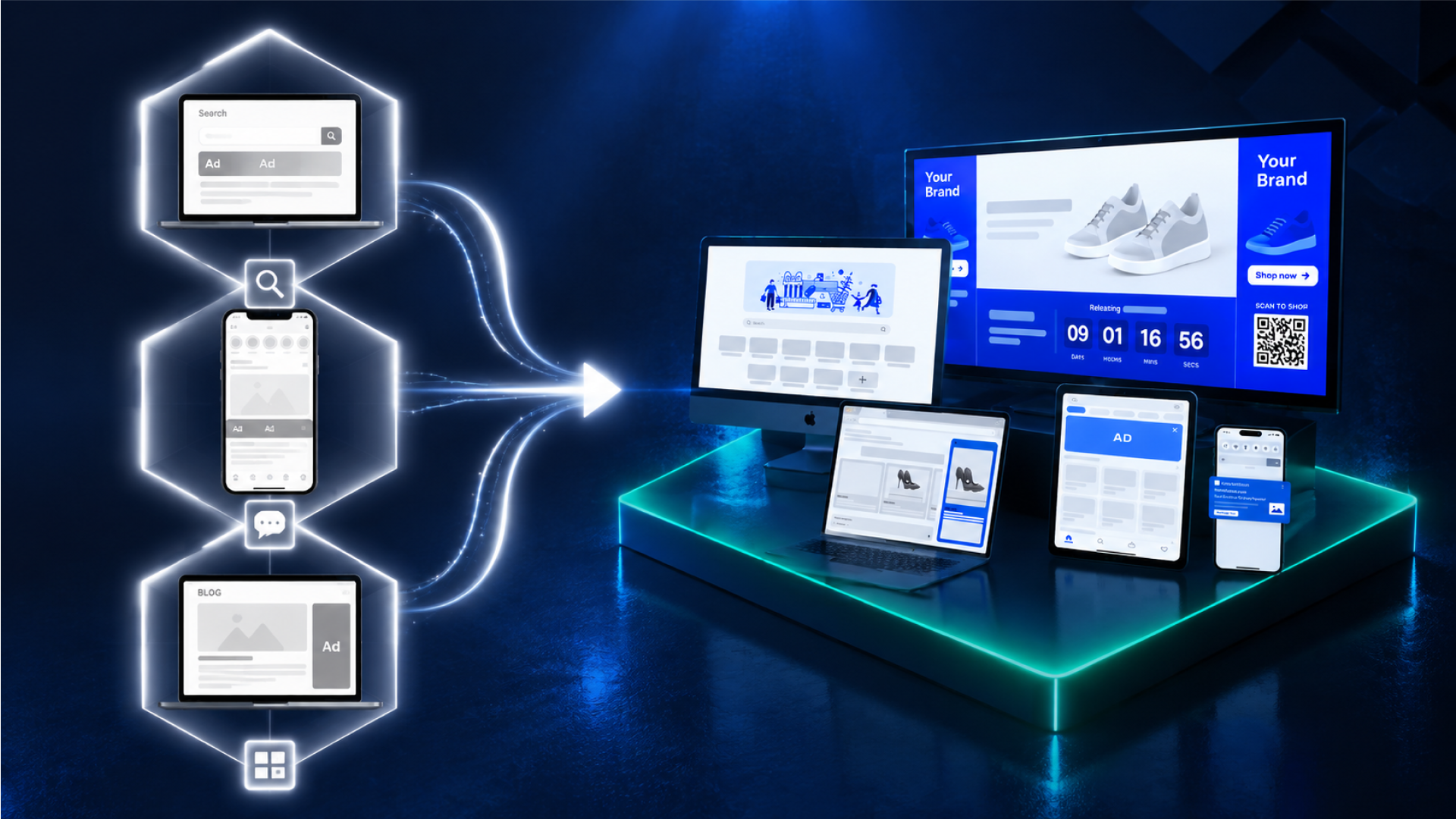
Summary: Enterprise native supply is advertising inventory built into products owned by large infrastructure companies: device manufacturers, browsers, operating systems, TV platforms and other access points. Because advertising is a secondary business for these companies, this inventory sits outside both the walled gardens and the open programmatic exchange. For advertisers, it offers incremental reach in high-attention, privacy-durable environments.
Where the budget went
For most of the last two decades, digital advertising has organised itself around three places: search, social, and the open programmatic exchange.
That happened for good reasons. All three were self-serve, reported back within hours, and offered close to infinite scale in a single interface. Every planner learned them first, every agency built teams around them, and every procurement process was designed to buy them. When a channel is easy to buy and easy to defend internally, budget finds it.
In essence, this concentration was the market rewarding the path of least operational resistance. And the question worth asking now, is whether these channels are still sufficient on their own.
The point of diminishing returns
The cost is more than what most quarterly reviews make it look. When most of a budget sits inside two or three platforms, you compete in the same auctions as every other advertiser in your category. Prices rise, and the return on each additional pound falls. Past a certain point you’re no longer buying new customers, you’re buying additional frequency against people who already know you.
You also inherit the platforms’ terms: their measurement, their attribution windows, their definition of success. That’s a fair trade when a channel is delivering growth, and an expensive one when it’s mostly delivering repetition.
The open exchange has its own version. It has been commoditised for years, carries a real fraud burden, and the article inventory it depends on is being compressed as AI-generated answers absorb the search traffic that used to arrive on publisher pages.
None of which argues for spending less on the channels that work. It argues for knowing where the next increment of reach comes from, because it is increasingly unlikely to come from bidding harder in the same three places.
What “enterprise native” actually means
There is a large, well-established category of advertising inventory that sits outside all three, and it has been transacting at scale for years. What it has rarely had is a name, and consequently a line on the plan.
Native, because the placement is part of the product rather than something laid on top of it. A tile on a phone home screen, a placement on a browser start page, a unit inside a TV interface. These aren’t ads inserted into content, they’re ads built into the surface people are already using to get somewhere.
Enterprise, because of who owns the surface. Samsung, TCL, Opera and Xiaomi are not advertising companies. They are hardware and software businesses with enormous installed bases, for whom advertising is a secondary revenue line rather than the reason the product exists. That single fact explains almost everything else about how this inventory behaves.
It’s worth being precise about what enterprise native is not. It isn’t a sponsored article. It isn’t a promoted post in a social feed. It isn’t a display banner bought through an exchange. And it isn’t retail media, which is native to a shopping destination rather than to the products people use to reach one.
Where it lives
The clearest way to understand the category is to look at your own morning.
You pick up a phone and unlock it. That home screen belongs to a handset manufacturer. You open a browser and land on a start page, or open a new tab. That surface belongs to a browser company. You go to an app store, use a launcher, tap a keyboard, check a utility app. In the evening you switch on a television and the interface that greets you belongs to a TV manufacturer.
Every one of those is an access point: a moment where someone enters the internet rather than moves around inside it. The companies that own those moments are, almost without exception, infrastructure companies.
Take the browser start page specifically. It’s one of the most repeated moments in digital life, viewed hundreds of millions of times a day. It has never been available in the open exchange in any meaningful volume, and not for want of demand. The browser company simply doesn’t want every programmatic vendor in the market touching its users.
That’s the shape of the whole category: significant scale, owned directly, deliberately kept out of the open pipes.
Why it’s valuable
- It delivers genuinely incremental reach
The most useful property of these surfaces is who you find on them. Because they’re tied to devices and access points rather than to a logged-in social graph or a search query, the audience isn’t the same audience you’re already saturating in the walled gardens. For a large advertiser, that means net-new reach layered on top of existing spend, rather than more frequency against the same people. - It can’t be commoditised
Auction inventory converges on a market price, because supply is fungible and everyone can bid. Enterprise native supply doesn’t work that way. Each surface is finite, owned by a single company, and available only through a direct relationship with it. There’s no exchange to plug into and no way to bid your way in. That’s why the category has stayed premium while comparable display inventory has not. - It can’t be commoditised
Auction inventory converges on a market price, because supply is fungible and everyone can bid. Enterprise native supply doesn’t work that way. Each surface is finite, owned by a single company, and available only through a direct relationship with it. There’s no exchange to plug into and no way to bid your way in. That’s why the category has stayed premium while comparable display inventory has not. - It’s privacy-durable by construction
The reason this inventory never entered the open exchange is privacy. These companies hold significant relationships with their users and have consistently declined to let that data flow through open pipes. So these are permissioned, operator-controlled environments that were never built on third-party cookies, and haven’t needed retrofitting as the identity landscape changed. - It earns attention rather than interrupting it
Because the placement is part of the product, the interaction is different from an ad arriving mid-scroll. Someone opening a browser or unlocking a phone is looking at that surface with purpose. These are among the most-used surfaces in a person’s day and among the least-funded in a typical media plan. - It converts
Enterprise native is often filed under awareness, which undersells it. Placements sitting at the point where someone enters the internet sit early in a purchase, and often at several points during one. Advertising across Affinity’s enterprise native surfaces has driven more than $10 billion in commerce to date. - It’s structurally fraud resistant
Ad fraud is an incentive problem. It thrives where inventory is anonymous, resold through multiple hops and hard to trace. None of that describes a Samsung handset or the Opera browser: large, publicly accountable companies with substantial core businesses and no plausible interest in inflating advertising numbers. Fraud isn’t filtered out after the fact. It largely has no route in.
Why this matters now
The shape of the customer journey has changed too.
Discovery, consideration and purchase no longer happen in a fixed order. Someone might encounter a brand on a TV interface, research it weeks later in a browser, abandon it, see it again on a phone home screen, and buy through an entirely different route. Intent doesn’t arrive in a single moment. It forms gradually, across dozens of touchpoints, in environments the customer never consciously chose to visit.
Last-click attribution can’t see most of that. It credits the final touchpoint and discounts everything that made the final touchpoint possible, which produces predictable behaviour: over-investment in demand fulfilment, under-investment in demand creation.
Enterprise native surfaces sit exactly where that formation happens.
Why it’s difficult to buy well
If the value is clear, the obvious question is why this isn’t simply a standard line on every plan.
The answer is that acting on it in a coordinated way is a genuinely different problem from recognising it.
Every surface operates as its own environment. Its own formats and creative specs, its own inventory rules, its own commercial terms, its own reporting, its own market coverage. A handset manufacturer in Indonesia and a browser company in Europe have almost nothing in common operationally. There is no unified buying layer, because there’s no auction underneath to build one on.
So an advertiser trying to cover this category directly ends up managing dozens of relationships and bespoke insertion orders to assemble something that still isn’t a single campaign. For mid-market advertisers it’s frequently out of reach altogether: no account manager, no appetite for a long negotiation, no minimum spend worth the counterparty’s time.
This is how “omnichannel” so often ends up being a collection of disconnected single-channel executions presented as one strategy.
Where Affinity fits
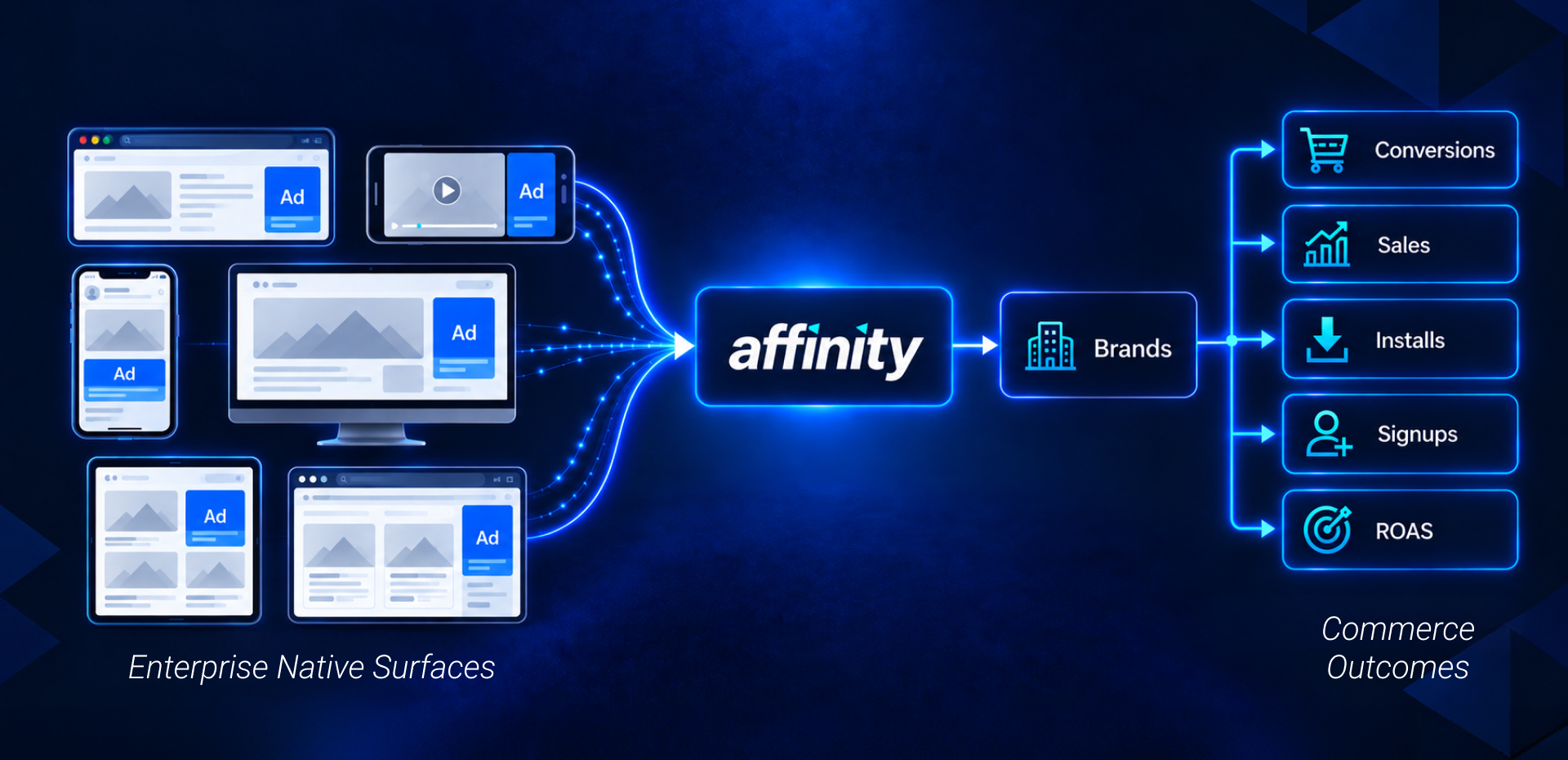
For most advertisers, these surfaces are effectively media dark. Enormous, addressable audiences that never appear in a plan, not because anyone decided against them, but because reaching them means doing the work of assembling the category one company at a time.
Affinity has spent two decades doing that work. We hold direct partnerships with the access points themselves: handset manufacturers including Samsung, Xiaomi, Huawei and Motorola, browsers including Opera, Samsung Internet, Microsoft Edge and Firefox, and TV platforms including TCL. In total, 2,400+ partners across 35 markets, with more than 62% of digital traffic flowing through browsers we operate in.
For an advertiser, that changes the unit of work. One relationship covers the enterprise native landscape, with consistent creative execution and consistent measurement across surfaces that would otherwise each be their own negotiation, integration and reporting format.
It also changes what’s accessible at all. Because we work with these companies directly and at volume, inventory and scale that isn’t practically reachable through a direct approach becomes available as a planned buy.
Built with the access points
Two decades of that work shows up as direct relationships with the surfaces themselves.
- Browsers: Opera, Opera GX, Samsung Internet, Microsoft Edge, Firefox, Avast Secure
- Smartphone manufacturers: Samsung, Xiaomi, Huawei, Motorola, OPPO, vivo
- TV platforms: TCL and other connected TV manufacturers
- Keyboards, launchers and utility apps: Bobble AI, Desh, Baidu Keyboard, and more
That’s 500+ publishers across 35+ markets, helping drive outcomes for 2000+ advertisers across a billion user touchpoints.
Search, social and the exchange aren’t going anywhere. But they’re no longer the whole of addressable digital advertising. Enterprise native supply is where a great deal of daily attention actually sits: incremental, premium, privacy-durable and demonstrably commercial.
So the question for the next planning cycle isn’t whether to move budget out of what works. What share of your spend is buying new customers, and what share is buying the same ones again?
FAQs
- Is enterprise native supply the same as native advertising?
It shares the principle and not the format. Native advertising usually describes a sponsored article or a promoted post designed to blend into surrounding content. Enterprise native applies the same idea, advertising that fits the environment it appears in, to the products people use to access the internet: phones, browsers, operating systems and TV platforms. - Is it programmatic?
No. This inventory sits outside the open programmatic exchange, mostly because the companies that own it have chosen not to route user data through open pipes. It’s bought through direct relationships with the surface owners rather than through real-time bidding. - How is it different from retail media?
Retail media is native to a shopping destination and reaches people who have already arrived somewhere with the intention to buy. Enterprise native is native to the access point and reaches people earlier, as intent is forming, before a destination has been chosen. - Is it brand safe?
Structurally, yes. Every placement runs on a surface owned and operated by a single identifiable company with a substantial core business to protect. There’s no anonymous resold inventory, no long reseller chain, and no incentive anywhere in the chain to misrepresent what was delivered

Affinity Wins Two Awards at 2026 CJ Excellence Awards
New York, September 23, 2026: Affinity Global announced today that its publisher brands VEVE and SitePlug were honored with two awards at the 2026 CJ Excellence Awards: Publisher of the Year for VEVE and SitePlug by Affinity, and Best Channel Expansion and Activation Strategy for the Expedia Group x VEVE and SitePlug by Affinity partnership.
NucleusLinks Launches Product Feeds to Close Affiliate Commerce Data Gap
Chicago, August 14, 2026: NucleusLinks, the affiliate marketing software platform built within the Affinity ecosystem, today announced the launch of Product Feeds, a product data infrastructure layer designed to help affiliate publishers standardize, enrich, and activate merchant data at scale.
Affinity expands its business in Germany and opens an office in Paris
Affinity is significantly expanding its business in the DACH region. Through its platform mCanvas, a leading provider of high-impact mobile and CTV advertising experiences, the company is filling several key roles at its Berlin location. With the opening of a new office in Paris, Affinity is also accelerating its European expansion.
Affinity Joins AdCP as Founding Member to Bring Enterprise Native Supply into Advertising’s AI Future
Press Release Share this Affinity Joins AdCP as Founding Member to Bring Enterprise Native Supply into Advertising’s AI Future Affinity to contribute towards agentic standards
TCL FFalcon Partners with Affinity to Offer Programmatic Ad Access Across its Smart TV Ecosystem in 160+ Countries
Press Release Share this TCL FFalcon Partners with Affinity to Offer Programmatic Ad Access Across its Smart TV Ecosystem in 160+ Countries New York, 7th
Affinity acquires Affilizz
Press Release Share this Affinity acquires Affilizz to strengthen AI-powered affiliate monetization worldwide French company Affilizz, known popularly for its AI-driven shopping widgets that power

CJ Excellence Awards 2026
California, September 18, 2026: Affinity Global announced it won both categories it entered at the 2026 CJ Excellence Awards: Publisher of the Year for VEVE & SitePlug by Affinity, and Best Channel Expansion & Activation Strategy for its work with Expedia Group.

Affinity Global Named AdTech of the Year at the Advertising Awards Asia-Pacific 2026
Affinity Global won the Grand Prix for AdTech of the Year at the inaugural Advertising Awards Asia-Pacific, taking five trophies for campaigns across Indonesia, Singapore and Malaysia.

Affinity Wins 10 Awards at The Great Indian BFSI & Fintech Awards 2026
mCanvas and VEVE won ten awards between them at the 6th edition of The Great Indian BFSI & Fintech Awards, across campaign and individual categories for India’s leading BFSI brands.

mCanvas Wins Three Awards at the Connected TV Asia Awards 2026
mCanvas has won two Gold and one Bronze at the Connected TV Asia Awards 2026, India’s only awards dedicated to Connected TV advertising, for campaigns with Sebamed, Dr. Fixit and LIC.

mCanvas Wins Four Awards at the DIGIXX Summit & Awards 2026
mCanvas won one Gold, two Silver and one Bronze at the 10th edition of Adgully’s DIGIXX Summit & Awards, for campaigns across India and Thailand.

Affinity Wins 10 Awards at the MOBEXX Summit & Awards 2026
mCanvas and VEVE won ten awards between them at the 9th MOBEXX Summit & Awards in New Delhi, recognising campaign work across India, Indonesia and Singapore.

What is Enterprise Native Supply, and What it Means for Advertisers
Enterprise native supply is advertising inventory built into products owned by large infrastructure companies: device manufacturers, browsers, operating systems, TV platforms and other access points. Because advertising is a secondary business for these companies, this inventory sits outside both the walled gardens and the open programmatic exchange. For advertisers, it offers incremental reach in high-attention, privacy-durable environments.

Is Commerce Media Advertising’s Next Performance Channel?
Commerce media is rewriting digital advertising combining first-party data and closed-loop measurement in marketing campaigns. Here is what marketers and publishers need to understand in 2026.

Your Layout, Your Rules: How Affinity Helps Publishers Monetize Without Disruption
Monetization is a team sport, and to succeed, you need the right players on your side, working together. For digital publishers today – whether you’re an internet browser, utility app, OEM, or a niche content platform, the challenge isn’t about content quality. It’s about monetization. More specifically: how do you scale premium brand demand globally, without building a complex and costly in-house sales team?
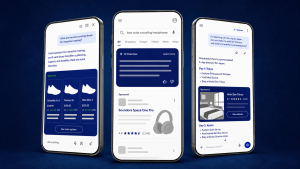
Are We The Last Generation Of Search Marketers?
For decades, search marketing was built around that behaviour. But that behaviour is starting to change. AI is shifting search from a list of links to a more conversational experience.
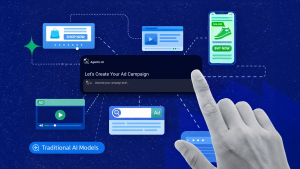
Agentic AI Will Redefine Advertising – Context Will Make It Work
Advertising is entering a new era where competitive advantage will come not from more data, but from better context. As AI systems evolve from passive tools into autonomous decision-makers, they are giving rise to agentic AI, systems that can automate and unify advertising channels and how decisions are made across them.
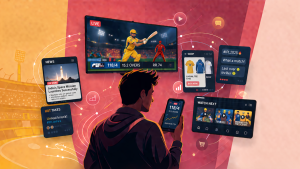
Rethinking IPL Advertising: From single-screen reach to multi-screen relevance
The Indian Premier League (IPL) has evolved into far more than a sporting event. For brands, IPL represents one of the most valuable opportunities to connect with audiences at scale. However, something fundamental has changed in recent years; IPL is no longer a single screen experience.
One Response