


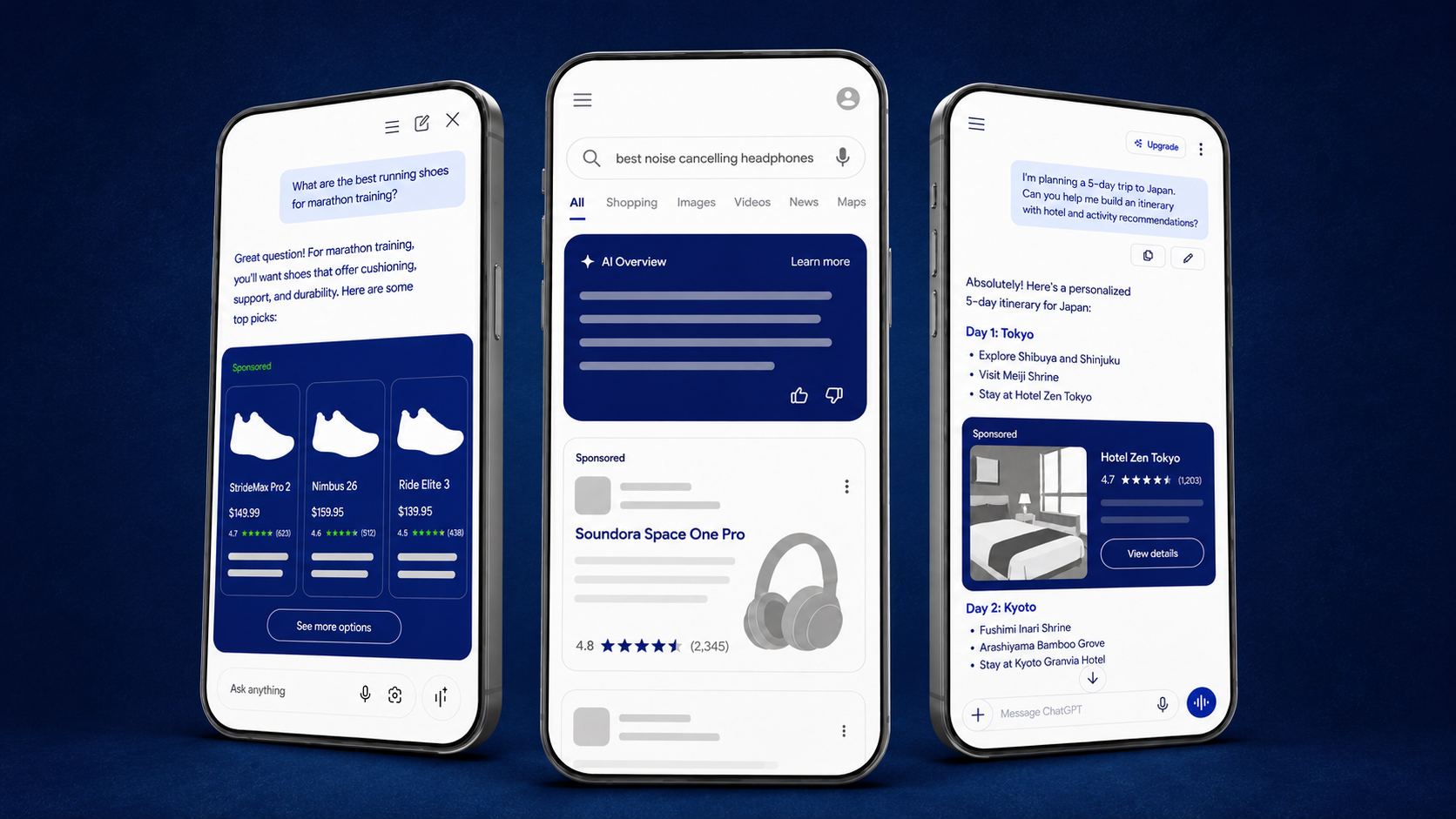
As consumers move from searching to asking, marketers must rethink how influence is earned.
Once Google monetized search, it became one of the clearest windows into consumer intent. A user typed a query, the algorithm ranked the results, and advertisers competed to appear at the right moment.
For decades, search marketing was built around that behaviour. But that behaviour is starting to change. AI is shifting search from a list of links to a more conversational experience.
Consumers are not just looking for information; they are asking questions, comparing options and getting help with decisions in the same interaction. That changes what search marketers are optimizing for. If the consumer journey moves from keywords and clicks to conversations and recommendations, brands need to rethink how they show up.
The money is already starting to move in that direction.
AI advertising spend is projected to reach $68 billion by 2030, roughly one in every eight advertising dollars globally.* This is not just a new media format. It reflects a larger shift in how consumers discover, evaluate and decide.
Where Are The Budgets Moving?
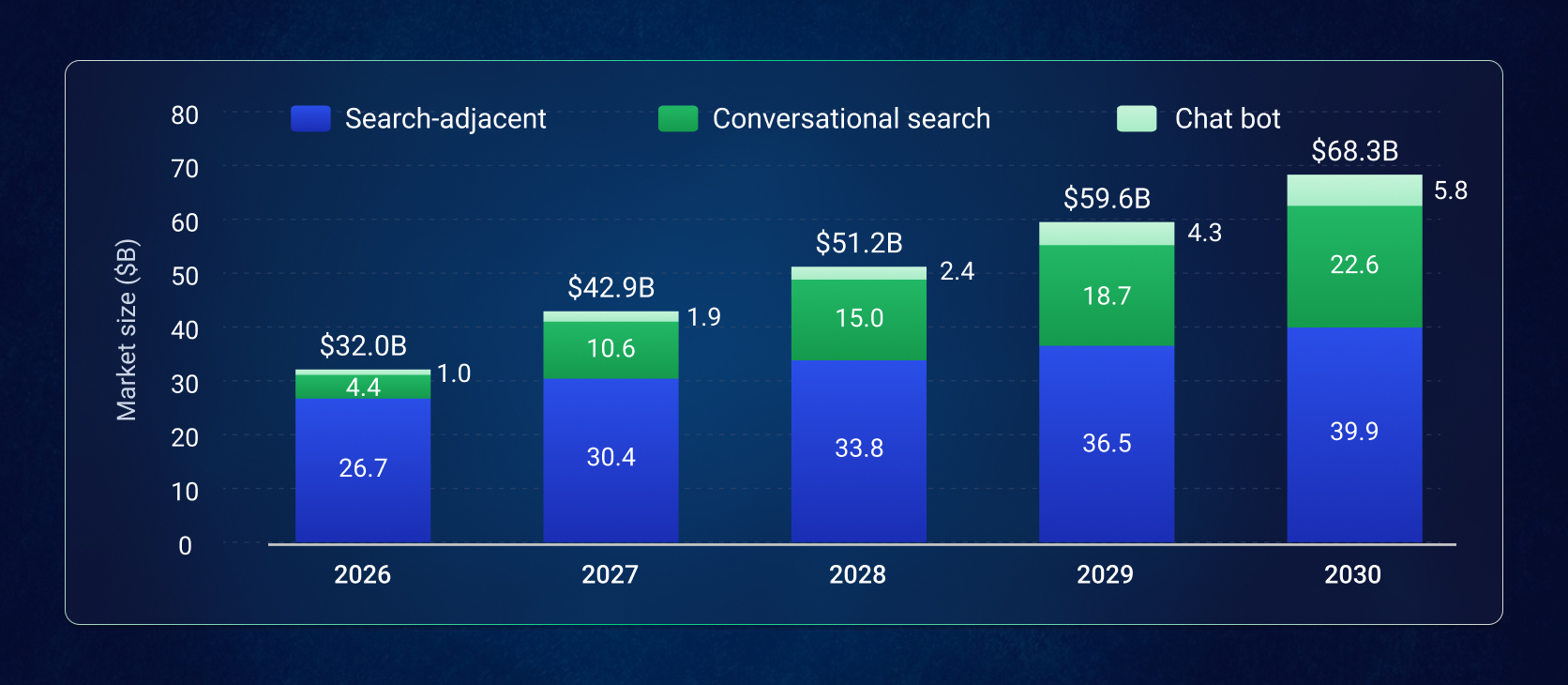
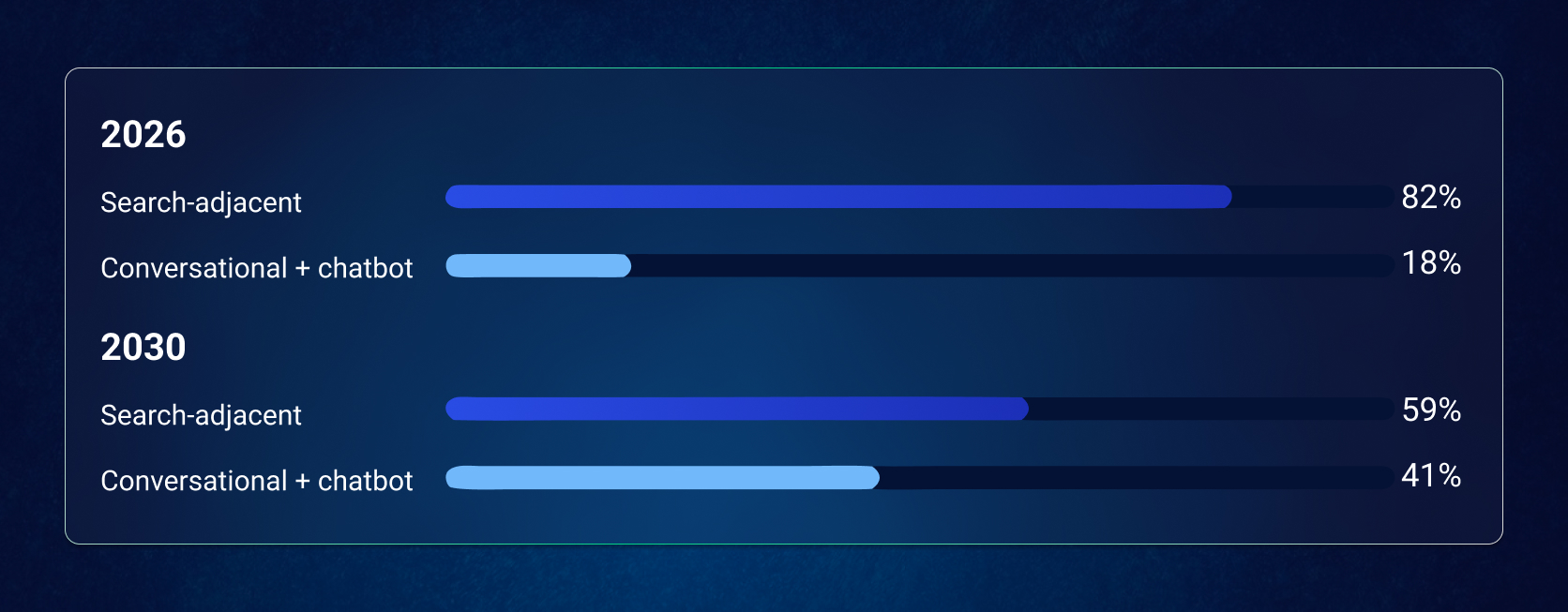
AI advertising spans three main formats: search-adjacent (AI-enhanced results and smart overlays within familiar search interfaces), conversational search, and AI chatbots. In 2026, search-adjacent holds the commanding majority with 82% and the rest only held a combined share of 18%.*
By 2030, the picture looks different. Search-adjacent drops from 82% to 59%, while conversational and chatbot formats grow to a combined share exceeding 41%.*
The rebalancing matters because it signals where consumer attention is gravitating, not just where budgets currently sit.
The Consumer Side of the Shift
AI is now embedded in daily life — smartphones, CTV, smart speakers, search engines. The interface has changed, and with it, the behaviour.
People increasingly use AI not just to look something up but to think something through. They’re comparing options, asking follow-up questions, and arriving at decisions through dialogue rather than scanning a list of blue links.
The query is no longer a starting point – it’s the whole journey.
For search marketers, this is the critical shift.
Search marketing was built on the assumption that consumers would navigate through information before making a decision. AI is beginning to remove much of that navigation.
The query is no longer simply a gateway to information. It is increasingly becoming the place where information is interpreted, options are compared and decisions are made.
That doesn’t mean search disappears. But it does mean the skills, signals and strategies that defined search marketing for the last two decades may not define it for the next two.
What This Means for Marketers
The shift is forcing advertisers to rethink something fundamental: where, and how, the moment of influence actually happens.
In traditional search, advertisers competed for ranked placement. In an AI-powered environment, placement is no longer bought, it’s earned. The AI decides what to surface, what to recommend and what to act on, based on relevance, trustworthiness and contextual fit. Advertisers who built their strategies around keyword bidding and click-through rates are now operating in an environment that doesn’t reward those signals in the same way.
The data signals this clearly. With 33% of US AI ad budgets already flowing to conversational search and chatbot advertising growing at 52% CAGR*, the formats consumers are gravitating toward are precisely the ones that demand a different kind of advertiser presence, one built on usefulness, not interruption.
Advertisers that continue optimising for yesterday’s interface will find diminishing returns in an environment that has already moved on. The question isn’t whether to adapt, it’s how quickly brands can shift from buying attention to earning it.
The Next Generation of Search Marketers
If consumers increasingly discover, evaluate and purchase through AI, then search marketing doesn’t disappear, it evolves. The objective remains the same: influence consumer decisions. The mechanics, however, are changing rapidly.
As AI becomes the interface between consumers and brands, four principles are likely to define the next generation of search marketing.
- Become the source of information – AI systems favour content that helps answer questions and resolve uncertainty. Brands that create authoritative, structured and verifiable information are more likely to become part of the response rather than compete for attention around it.
- Optimise for context, not keywords – Consumers are moving from simple searches to nuanced conversations. Success will depend less on matching keywords and more on understanding the context behind a decision like who the user is, what they need and what influences their choice in that moment.
- Show up to the AI, not just the consumer – Increasingly, AI is not just recommending products, it is evaluating, filtering and shortlisting options on behalf of consumers. Brands need to think about how they are interpreted by AI systems, not just how they are perceived by people.
- Influence the decision, not the click – The traditional search journey was built around rankings, traffic and clicks. AI compresses discovery, evaluation and recommendation into a single interaction. Brands that support the entire decision-making process will have an advantage over those optimised only for visibility.
The winners in the next era of advertising may not be the brands with the largest budgets, but the brands most useful to both consumers and the systems guiding them.
The Window is Now
Search marketing was built to help brands get found. AI marketing will be built to help brands get chosen. The search bar isn’t going away. But the consumers it once owned are learning to ask for more than a list of links.
Search marketing was built to help brands get found. AI marketing will be built to help brands get chosen.
While we may not be the last generation of marketers. But we might be the last generation of search marketers.
*Source – US AI Advertising Forecast 2026 – EMARKETER

Affinity Wins Two Awards at 2026 CJ Excellence Awards
New York, September 23, 2026: Affinity Global announced today that its publisher brands VEVE and SitePlug were honored with two awards at the 2026 CJ Excellence Awards: Publisher of the Year for VEVE and SitePlug by Affinity, and Best Channel Expansion and Activation Strategy for the Expedia Group x VEVE and SitePlug by Affinity partnership.
NucleusLinks Launches Product Feeds to Close Affiliate Commerce Data Gap
Chicago, August 14, 2026: NucleusLinks, the affiliate marketing software platform built within the Affinity ecosystem, today announced the launch of Product Feeds, a product data infrastructure layer designed to help affiliate publishers standardize, enrich, and activate merchant data at scale.
Affinity expands its business in Germany and opens an office in Paris
Affinity is significantly expanding its business in the DACH region. Through its platform mCanvas, a leading provider of high-impact mobile and CTV advertising experiences, the company is filling several key roles at its Berlin location. With the opening of a new office in Paris, Affinity is also accelerating its European expansion.
Affinity Joins AdCP as Founding Member to Bring Enterprise Native Supply into Advertising’s AI Future
Press Release Share this Affinity Joins AdCP as Founding Member to Bring Enterprise Native Supply into Advertising’s AI Future Affinity to contribute towards agentic standards
TCL FFalcon Partners with Affinity to Offer Programmatic Ad Access Across its Smart TV Ecosystem in 160+ Countries
Press Release Share this TCL FFalcon Partners with Affinity to Offer Programmatic Ad Access Across its Smart TV Ecosystem in 160+ Countries New York, 7th
Affinity acquires Affilizz
Press Release Share this Affinity acquires Affilizz to strengthen AI-powered affiliate monetization worldwide French company Affilizz, known popularly for its AI-driven shopping widgets that power


CJ Excellence Awards 2026
California, September 18, 2026: Affinity Global announced it won both categories it entered at the 2026 CJ Excellence Awards: Publisher of the Year for VEVE & SitePlug by Affinity, and Best Channel Expansion & Activation Strategy for its work with Expedia Group.
Affinity Global Named AdTech of the Year at the Advertising Awards Asia-Pacific 2026
Affinity Global won the Grand Prix for AdTech of the Year at the inaugural Advertising Awards Asia-Pacific, taking five trophies for campaigns across Indonesia, Singapore and Malaysia.
Affinity Wins 10 Awards at The Great Indian BFSI & Fintech Awards 2026
mCanvas and VEVE won ten awards between them at the 6th edition of The Great Indian BFSI & Fintech Awards, across campaign and individual categories for India’s leading BFSI brands.

mCanvas Wins Three Awards at the Connected TV Asia Awards 2026
mCanvas has won two Gold and one Bronze at the Connected TV Asia Awards 2026, India’s only awards dedicated to Connected TV advertising, for campaigns with Sebamed, Dr. Fixit and LIC.

mCanvas Wins Four Awards at the DIGIXX Summit & Awards 2026
mCanvas won one Gold, two Silver and one Bronze at the 10th edition of Adgully’s DIGIXX Summit & Awards, for campaigns across India and Thailand.
Affinity Wins 10 Awards at the MOBEXX Summit & Awards 2026
mCanvas and VEVE won ten awards between them at the 9th MOBEXX Summit & Awards in New Delhi, recognising campaign work across India, Indonesia and Singapore.

Is Commerce Media Advertising’s Next Performance Channel?
Commerce media is rewriting digital advertising combining first-party data and closed-loop measurement in marketing campaigns. Here is what marketers and publishers need to understand in 2026.

Your Layout, Your Rules: How Affinity Helps Publishers Monetize Without Disruption
Monetization is a team sport, and to succeed, you need the right players on your side, working together. For digital publishers today – whether you’re an internet browser, utility app, OEM, or a niche content platform, the challenge isn’t about content quality. It’s about monetization. More specifically: how do you scale premium brand demand globally, without building a complex and costly in-house sales team?
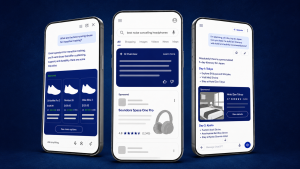
Are We The Last Generation Of Search Marketers?
For decades, search marketing was built around that behaviour. But that behaviour is starting to change. AI is shifting search from a list of links to a more conversational experience.
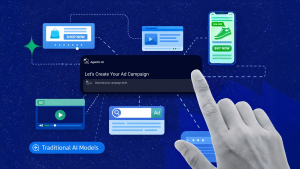
Agentic AI Will Redefine Advertising – Context Will Make It Work
Advertising is entering a new era where competitive advantage will come not from more data, but from better context. As AI systems evolve from passive tools into autonomous decision-makers, they are giving rise to agentic AI, systems that can automate and unify advertising channels and how decisions are made across them.

Rethinking IPL Advertising: From single-screen reach to multi-screen relevance
The Indian Premier League (IPL) has evolved into far more than a sporting event. For brands, IPL represents one of the most valuable opportunities to connect with audiences at scale. However, something fundamental has changed in recent years; IPL is no longer a single screen experience.

How to Scale Global Brand Demand without Building an In-house Sales Team
Monetization is a team sport, and to succeed, you need the right players on your side, working together. For digital publishers today – whether you’re an internet browser, utility app, OEM, or a niche content platform, the challenge isn’t about content quality. It’s about monetization. More specifically: how do you scale premium brand demand globally, without building a complex and costly in-house sales team?
One Response