Commerce media is rewriting digital advertising combining first-party data and closed-loop measurement in marketing campaigns. Here is what marketers and publishers need to understand in 2026.
Something fundamental has changed in digital advertising. Not just how ads are bought and sold, but what advertising is actually supposed to do.
For years, the industry optimised for impressions, clicks, and reach. Campaigns were judged on how many people they reached, not whether those people did anything commercially meaningful afterward. The feedback loop between media spend and business outcome was broken and most of the industry accepted this as a structural limitation.
Commerce media replaces that assumption with actual data.
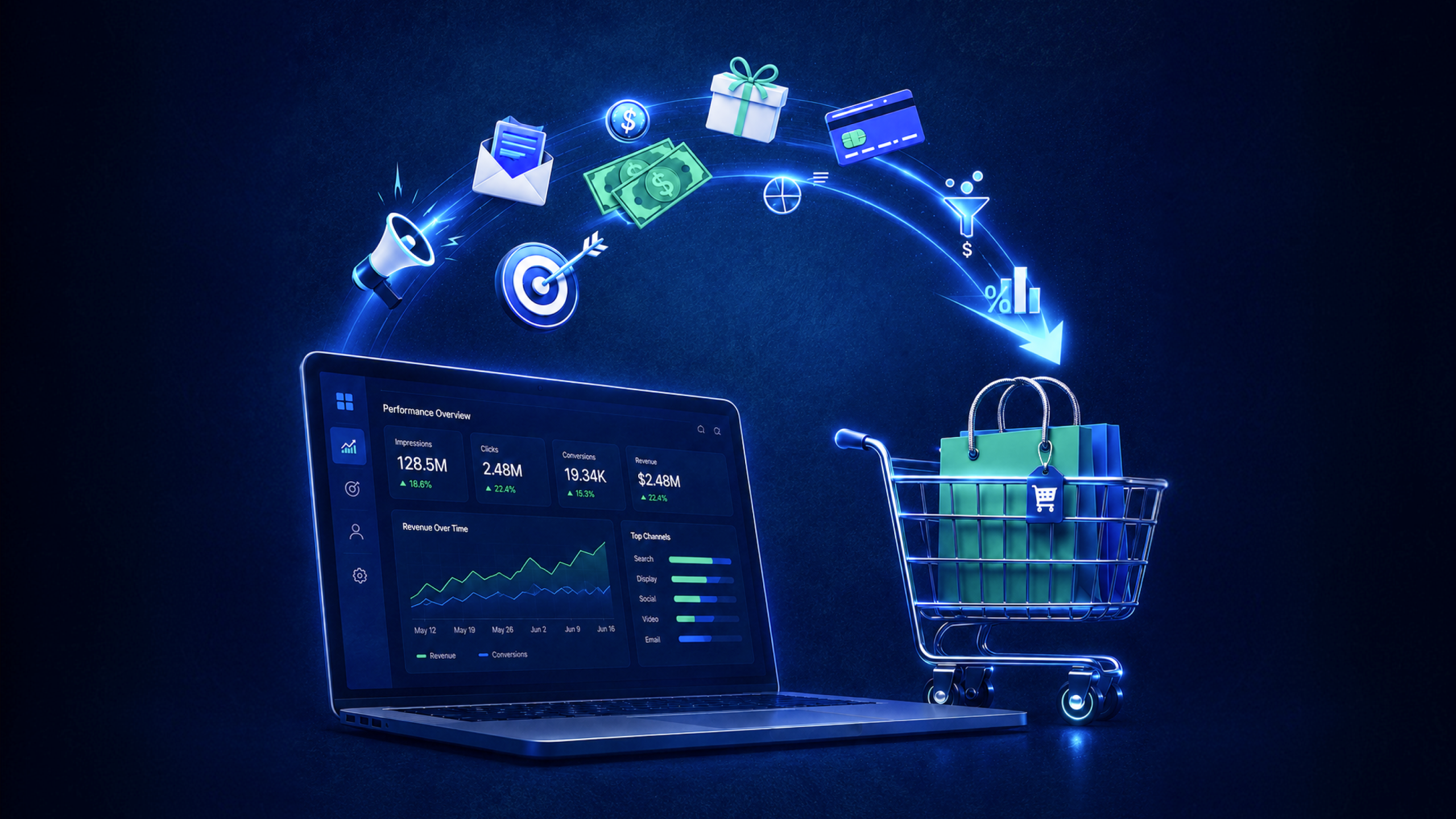
It is a data-driven approach to advertising that connects what people see on the internet to what they actually buy, using first-party customer data, real commerce signals, and closed-loop measurement to tie media spend directly to business results. Not proxies, not modelled estimates, but actual outcomes.
In 2026, commerce media has moved from emerging concept to mainstream imperative. For advertisers, it is the model that finally makes media spend accountable. For publishers, it is the framework that compensates them for the intent they generate, not just the impressions.
What Commerce Media Actually Is
Commerce media is a data-driven method of buying advertising that uses first-party customer data like transactions, browsing behaviour, loyalty signals, app events to deliver targeted ads and connect them directly to sales through closed-loop measurement.
That definition has three parts, and all three matter equally.
- First-party data – Commerce media is not built on third-party cookies or assumed demographics. It is built on data that brands, retailers, and publishers collect directly from their own customers, authenticated, consented, and commercially meaningful. This is what makes targeting precise rather than approximate.
- Real shopping signals – Commerce media activates on intent like what consumers are actively browsing, comparing, and moving toward purchasing. A user reading a product comparison article, a shopper adding items to a wish list, a customer returning to a category page for the third time in a week – these are signals that indicate purchase readiness, and commerce media is built to act on them.
- Closed-loop measurement – This is what separates commerce media from everything that preceded it. Closed-loop measurement connects the ad impression to the actual purchase, not just a click or probability, but a verified sale. Advertisers can see which campaigns drove incremental revenue and where budget should move, making your spends accountable.
$1.3T in enterprise value that commerce media could unlock in the US alone
(McKinsey, 2026)
Together, these three elements create an advertising model that is fundamentally more accountable than traditional digital advertising, reaching audiences at the right moment, with the right signal, and measuring whether it worked.
The Open Internet Opportunity
The clearest example of commerce media to date has been retail media such as Amazon Ads, Walmart Connect, and similar networks built on first-party shopper data. But commerce media is not bounded by retailers.
Commerce intent, the moment when a consumer is actively researching and moving toward a purchase decision, lives across the entire open internet: editorial content, personal finance platforms, travel and lifestyle publishing, app environments, and browser surfaces far beyond a retailer’s ecosystem. Beyond the walled gardens and programmatic.
Enterprise-grade publishers and platforms are now building commerce media capabilities in these environments, packaging their audience data and intent signals as commerce inventory for advertisers who want to reach consumers earlier in the journey.
This is the gap commerce media is closing. The content environment where preference is formed and the commerce environment where the transaction completes are no distant stages and commerce media makes them part of the same measurable, accountable system.
What This Means for Advertisers
For advertisers, commerce media changes the fundamental question they can ask of their media spend. Instead of ‘how many people saw this ad?’, the question becomes ‘how many sales did this ad drive?’ Commerce media gives advertisers three capabilities that traditional digital advertising cannot provide such as intent-based targeting, full funnel accountability and closed-loop measurement.
But perhaps, the most significant shift is this – commerce media frees brands from dependence on search and social as default homes for performance budgets. The open internet which is powered by first-party data from smartphones, browsers, apps and payments platform now offers access to intent signals that are grounded in how people actually live, not just what they last clicked on.
For brands, willing to look beyond the walled gardens, that is a meaningfully sharper, and more human picture of purchase intent. The result is advertising that compounds results with each campaign building sharper targeting, better measurement, and stronger commerce outcomes than the one before it.
What This Means for Publishers
Commerce media is an opportunity for everyone in the open web to be a publisher.
Smartphones know how their users start their mornings. Browsers know what users research before a major purchase, payment apps know what consumers spends, retail apps know what’s in your wish list and what you add to your cart. AI is just a human companion at this point, creating meal plans and holiday itinerary. This is not just inferred behaviour but credible record of how real people move through their lives, every single day. The organizations holding this data, device manufacturers, fintech platforms, retail apps, browsers, are sitting of data goldmine that advertisers kill for.
Commerce media gives them the infrastructure to do exactly that. All publishers need access to is advertiser demand.
This is how the open web breaks the monopoly of default search and social. Not by competing on their terms, but by offering something they fundamentally cannot: proximity to the human, not just their algorithm.
Commerce media is the mechanism that turns this proximity into a media business and advertisers who plug into this layer gain a truer, sharper picture of intent than any walled gardens can provide.
What Is a Full-Stack Commerce Media Platform?
The central promise of commerce media – connecting advertising to real commerce outcomes – depends on something that point solutions cannot deliver: a system where advertiser intelligence and publisher intelligence operate inside the same infrastructure, informing each other continuously.
In most of the current market, this loop is broken. Advertisers optimise campaigns without visibility into how content context shapes audience intent or which placements get the highest value for advertisers.
Publishers hold high-value inventories and 1st-party data without real access to advertiser demand and the expertise to turn their inventories into yielding media placements.
Both sides are working with an incomplete picture.
A full-stack Commerce Media Platform closes this loop; a platform where demand-side and supply-side are connected by shared intelligence, with signals flowing from advertiser campaigns into publisher yield decisions, and from publisher content contexts into advertiser targeting. Every transaction produces intelligence that makes the next one sharper.
When publisher context and advertiser demand operate inside the same intelligence layer, results on both sides compound – the targeting improves, inventory commands more, and outcomes grow in both directions.
55% of advertisers plan to increase Commerce Media Platforms in the next 12 months, shifting spend from social, display and search
(McKinsey, 2026)
A full-stack Commerce Media Platform is defined by four capabilities that must operate together:
- Unique audience reach — Built on verified first-party data and authenticated shopping signals across a scaled publisher network, enabling targeting on actual purchase intent, not modelled proxies.
- Omnichannel activation — A single campaign framework operating across on-site, off-site, display, native, video, CTV, and in-app surfaces simultaneously, with unified frequency management across screens.
- Full-funnel measurement — Connecting brand exposure to mid-funnel engagement to lower-funnel conversion in a single attribution model, with incrementality built into the architecture from the start.
- Embedded AI — Operating continuously across bidding, targeting, yield optimisation, and creative personalisation, acting on live signals at a speed no human workflow can match.
Introducing Affinity Commerce Ecosystem
Affinity Commerce Ecosystem is a full stack Commerce Media platform consolidating demand-side advertising, supply-side monetisation, and shared audience intelligence under one connected infrastructure, serving advertisers and publishers simultaneously.
Commerce media value is created at the intersection of demand and supply. An advertiser’s ability to reach high-intent audiences depends on the quality and contextual depth of the publisher network beneath them. A publisher’s ability to command premium yield depends on the precision with which advertiser demand is matched to their inventory. Affinity Commerce Ecosystem improves both sides, and makes the intelligence generated on each available to the other.
THE NETWORK SIDE
- mCanvas — High-impact, immersive CTV and mobile ad formats designed to engage audiences at the moment of product discovery and consideration, catering to the top funnel.
- VEVE — A performance-driven native advertising network connecting brands to contextually relevant publisher inventory across smartphones and browsers, reaching consumers in active consideration mode and delivering against middle funnel conversions.
- Siteplug — A commerce touchpoint that activates purchase intent at the precise moment consumers are navigating toward a transaction, capturing high-intent signals at a surface no other network can reach.
THE PUBLISHER TECHNOLOGY SIDE
- NucleusLinks — An AI-powered affiliate marketing platform that simplifies affiliate operations and helps publishers maximise earnings through smart automation.
- YieldSolutions — A publisher monetisation platform that maximises revenue simultaneously across programmatic, direct, and commerce demand, with unified reporting and real-time optimisation.
- Opinary — An opinion and polling format that surfaces audience intent signals directly within editorial content – generating first-party data and contextual intelligence that improves both publisher yield and advertiser targeting precision.
Affinity Commerce Ecosystem is enabling it all: publisher context signals inform advertiser targeting decisions, and advertiser demand signals inform publisher yield optimisation. The feedback loop between content performance and campaign performance is live, continuous, and compounding.
~1/3 of advertisers plan to use AI daily across commerce media planning, activation, and measurement making embedded AI a core criterion for full stack partner selection
(McKinsey, 2026)
Supporting all of this is agentic AI, the capability that allows the network to act and optimise across campaigns, screens, and touchpoints simultaneously, without waiting for human intervention at each decision point. From real-time budget reallocation to predictive intent targeting and dynamic creative personalisation, agentic AI lets brands do significantly more with significantly less.
Learn what agentic AI can do for your brand: Agentic AI Will Redefine Advertising — Context Will Make It Work
The Time to Build Is Now
The data infrastructure to connect content and commerce exists. The measurement tools to prove the connection are mature. The AI to operate across them at scale is live. What remains is execution and the choice of which infrastructure to build on.
Affinity Commerce Ecosystem is built to accelerate both journeys, for advertisers who need a full-funnel commerce media partner operating across every screen and touchpoint, and for publishers who need the infrastructure and the demand to convert their contextual intelligence into premium commerce yield.
Commerce media is not where advertiser is going. It’s where accountability lives and makes advertising more rounded and credible, something that wasn’t as apparent a few years ago.













One Response